2008–2012 · Interfaces, networks and collective life
These projects survived in two old server directories, oldpublichtml
and www. Recovered in September 2026, they fill a gap between the
earlier personal pages and later research publications: small tools for taking a
photograph, seeing a social network, printing a tweet, exploring search patterns
or working with other people's ideas.
Historical exhibits, not restarted services.
The pages below are static reconstructions and descriptions. Original text and code
are linked as inert text files; Flash, login, tracking, camera capture and upload
functions are not activated. Uploaded photographs and research databases are not
republished. File modification dates are evidence about the surviving copy, not
automatically the date of invention or first publication.
Photo Capture: a webcam picture as a social widget
January–February 2008 · Homepage modified 4 February; help page 19 February
The old server homepage describes a Flash webcam tool for experimenting with
widgets and their spread through social networks. There were versions for Google
Desktop, Netvibes UWA and an ordinary web page, plus an untested iGoogle route.
The Netvibes source credits “A Rivero for Hurriquest”; the historical host was
demofoto.hurriquest.eu. The proposed OpenSocial version is marked
“To be done”, not evidence of a finished application.
The server-backed version associated a photograph with an ID and a persistent
URL, so another widget could show a changing picture or mood. A separate version
kept the captured image in a browser data: URI without uploading it.
That distinction—sharing through a service versus keeping a tool local—is already
explicit in the original documentation.
The surviving compact gadget illustration. Visitors' camera uploads are excluded.
This is a different project from the earlier
webcam-controlled mouse. The documentation
also preserves contemporary browser limitations, camera-selection problems and
the use of a photo URL with Gravatar.
1 April 2008 · Preserved modification date of the page and graphics
A small landing page says the site is under construction and that Ibercivis
will soon be launched publicly. It describes a platform linking citizens'
computers for Spanish researchers, with graphics for BIFI, CETA, CIEMAT, ITACA,
CSIC and RedIRIS. This is a contemporary project artefact, not a claim that I
personally designed every institutional graphic.
The preserved pre-launch artwork. The original HTML used an image-directory path that does not match the copied layout; this exhibit uses the recovered local image.
24 March 2011 · Page and application-script modification dates
GraphEvent asked for a Facebook event ID and drew relationships among its
guests. The interface offered IDs, names and pictures, with dragging, zooming and
extra layout iterations. The surviving implementation queries attending and
unsure guests, then their friendships, and draws a force-directed network using
the JavaScript InfoVis Toolkit.
The page names apps.facebook.com/graphevent/. Its code acknowledges
an earlier nmdscript.js demonstration; the toolkit and that starting
point should not be presented as my original inventions. The recovered source
documents an application assembled around those ingredients.
This exhibit does not contact Facebook, request permission to read events or
attempt to recover people's friendship graphs. The original login and query code
is preserved only for reading. It adds a practical social-network interface to
the research-publication record.
18–20 May 2011 · Git commit dates; local generated material continued into June
The README describes a tool that downloads tweets selected by subject or user
and makes printable sticker sheets. A browser or wkhtmltopdf turns
the output into something that can circulate away from a screen. The examples
refer to notenemosmiedo and tomalaplaza, connecting it to
the contemporary protest context.
Attribution matters. The recovered Git history credits XayOn
with the initial implementation and subsequent features on 18–19 May. My commit
of 20 May 2011, b8d6151, changes ScriptProposal.sh from
non-executable to executable. That proves a small participation in this checkout,
not authorship of the whole project. The README identifies the upstream project
as github.com/XayOn/RealLifeTwitter.
The interesting connection is between online communication and physical
distribution, alongside the 15M historical notes
and research on collective action. Old API-dependent scripts are not run here,
and the recovered collections of other people's tweets are not republished.
Danza de las estaciones: a map of seasonal searches
19–21 April 2012 · Final explanatory page modified 21 April
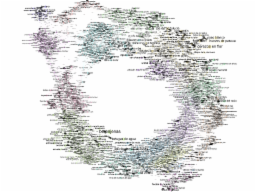
This is a map of periodic searches made from Spain. The original explanation
says that searches are placed near one another when their normalised time series
are similar, using Pearson correlation and Google Correlate. The final version
focuses on variations spanning at least two or three months; the text observes
that shorter windows favour local festivals and calendar holidays.
The original overview tile. Open the exhibit for the full-resolution map.
Explore the restored 8192 × 6144 map. Its original
image tiles now form a scrollable HTML/CSS image, without the old Seadragon
JavaScript viewer. Proximity is a property of the historical analysis and layout;
it does not establish causation between searches. The source data and complete
analysis pipeline have not been recovered here.
October–November 2012 · Revised main interface dated 11 November
The ci directory contains interface prototypes built around
neighbours' phrases. The code lets a user drag a phrase into an editable row,
keeps a history of changes, and provides backward and forward controls. Related
table experiments explore selecting several phrases and finding their positions
in responses. Tiny local JSON fixtures use placeholder phrases rather than a
substantial recovered study.
This documents an interest in interfaces for collective thinking, not merely
measuring activity after the fact. It is plausible early context for the later
collective-intelligence platform, but the archive alone does
not prove that one implementation directly became the other.
The historical source remains available for study; its external dependencies
are not loaded and the prototype is not presented as a currently working service.
The 2008 CV extracts extend the computing history back
to 1983 and add dated travel records, with discrepancies explicitly retained.
A local manuscript of A new Koide tuple:
strange-charm-bottom is dated 28 November 2011 both internally and by file
modification; it complements the publication entry rather than establishing a new
paper.
Other directories contain Spanish website-network maps, Zaragoza density plots,
institutional research-impact graphics and large social-network datasets. Their
provenance, interpretation or permission to republish needs more work; a filename
alone is not enough. They are not treated as ready public exhibits.
No 1990s personal webpage was identified in these two copied trees. Apache
distribution files with older dates are not evidence of an earlier personal site.
The original archival directories remain the source of record.